February 19, 2026 - 2152 views
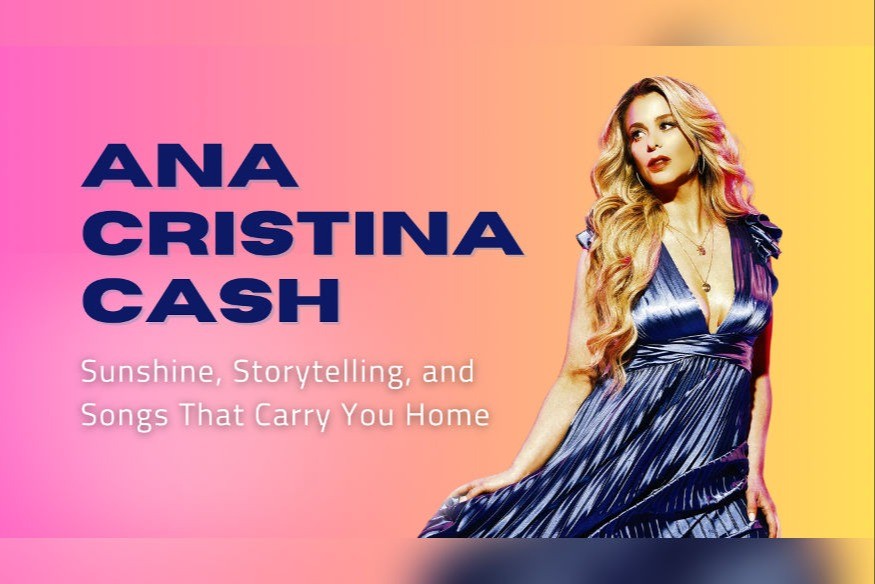
Ana Cristina Cash: Sunshine, Storytelling, and Songs That Carry You Home
Written by Tina Houser
She arrives wearing rose-colored glasses and a Mickey Mouse shirt, fresh off a family trip to Disney, and somehow it all makes perfect sense. Ana Cristina Cash has always lived at the intersection of memory and momentum, joy and gravity, playfulness and purpose. On Press Play Radio Conversations, she moves effortlessly from character breakfasts and Mickey waffles to exile, dictatorship, and the quiet weight of inherited history—all while promoting one of the most cohesive and emotionally resonant records of her career, The Sunshine State.
Cash speaks the way she writes songs: fluid, visual, deeply personal, and unafraid of contrast. One minute she’s laughing about buffet breakfasts at the Grand Floridian, the next she’s unpacking the lived realities of her Cuban family’s escape from the Castro regime and her empathy for Venezuelans navigating a similar struggle. She’s careful to insist she’s not political—she’s a singer—but her story refuses to stay neatly separated from history. For Cash, memory is not nostalgia for nostalgia’s sake; it’s evidence. It’s context. It’s the reason her voice carries conviction when she talks about freedom, censorship, and why young people should listen to those who lived through the systems being debated online.
That same instinct—to look backward in order to move forward—runs through The Sunshine State like a through-line. The album unfolds as a connected emotional landscape rather than a collection of singles. It opens gently, then loosens its shoulders, then reaches inward again. Even “Cheap Margaritas,” the one song on the record Cash didn’t co-write, feels like it was always meant to live here. Flirtatious and playful, it’s a song that understands joy doesn’t have to be profound to be meaningful. People hear it and tag their friends, their drinks, their nights out. Cash noticed something simple and powerful: margaritas make people happy. Sometimes that’s enough.
Visually, the record mirrors that layered approach. The album artwork—shot at the Cash cabin with photographer Gina Binkley—plays with color and light in a way that feels intentional even when it’s accidental. A blue dress reads purple under the lights, pink hues catch in her hair, her name rendered in green and red, the title glowing gold. It’s not branding for branding’s sake; it’s atmosphere. Sunshine, refracted.
“Florida Girl” is the emotional spine of the record, and Cash’s story behind it explains why. She traces the song back to orange groves near the Everglades, dirt roads, a wooden swing set, and a childhood defined by space and simplicity. In the second verse, memory narrows to her grandmother’s house and the sound of an ice cream truck—an image so specific it becomes universal. The house is gone. Her grandparents are gone. But the identity remains. No matter how far she’s traveled—from Miami to Los Angeles to Nashville—she’s still that Florida girl. The Sunshine State becomes both geography and mindset, a place you carry when you can’t go back.
That theme deepens with “Janice,” one of the most quietly devastating songs on the album. Written alone in a pool house with nothing but a guitar and a notepad, it’s about her first childhood friend—a girl who drifted through Florida, the Keys, and eventually Alaska, leaving behind only fragments of connection. The song isn’t about reunion so much as longing: the desire to curl back into a time before adulthood complicated everything. When Cash sings about visiting Alaska to see the Northern Lights, it lands less as a plan and more as a promise to herself—to remember who she was before life hardened its edges.
Throughout the conversation, Cash returns again and again to the idea of manifestation, not as hustle culture mythology but as quiet alignment. She tells a story about singing Loretta Lynn in the sacred circle of the Grand Ole Opry during a backstage tour in 2006, never imagining she’d one day perform there more than a dozen times. She didn’t force it. She didn’t strategize it. It happened because the seed was planted, unnoticed even by her. Years later, she found herself working alongside Loretta, living near the Cash cabin, stepping into rooms she once walked through as a tourist. Hindsight makes it look like destiny. In the moment, it was just life unfolding.
That same sense of strength without spectacle shows up in her Spanish-language tracks, particularly the Spanish version of “Cheap Margaritas” and Última Llamada. The latter, built from a title in her notebook rather than a lived event, becomes an anthem of self-worth and refusal. It’s rock-leaning, driven, unapologetic—proof that empowerment doesn’t have to be autobiographical to be authentic. In Spanish, the song sharpens, intensifies, and claims its space. As Cash jokes, everything sounds more dramatic in Spanish—but the emotion is real either way.
By the end of the conversation, what lingers isn’t just the quality of the songs, though they are undeniably strong. It’s the coherence of the woman behind them. Ana Cristina Cash is an artist shaped by migration, memory, family, and faith in unseen connections. She writes songs that feel good and songs that ache, often in the same breath. The Sunshine State isn’t just a tribute to Florida—it’s a meditation on where we come from, what we carry, and how joy and history coexist without canceling each other out.
In a musical landscape that often rewards immediacy over depth, Cash is playing a longer game. She’s building albums the way some people build lives—layer by layer, story by story, trusting that if she stays honest, the circle will keep widening. To learn more and follow Ana Cristina Cash’s journey, visit her Mosaic profile at https://mosaic.pressplay.me/profiles/ana-cristina-cash.


Comments(0)