March 30, 2026 - 2062 views
By Tina Houser
Some artists arrive polished. Others arrive possessed.
Bec Lauder feels like the latter.
By the time Press Play Conversations caught up with Bec Lauder, the frontwoman of Bec Lauder and The Noise was already sounding less like an emerging artist and more like someone in the middle of becoming exactly who she was meant to be. Her album The Vessel isn’t just a collection of alternative rock songs — it’s a messy, magnetic coming-of-age document about heartbreak, self-discovery, timing, and the kind of emotional collisions that leave permanent marks.
And Bec Lauder doesn’t hide any of it.
“I’m the only lyricist,” she says. “My music is really just almost like documentation of my life.”
That much is obvious the second you step into The Vessel. The album opens with “Bent Up,” a track that wasn’t originally meant to lead the record. But somewhere near the finish line, Lauder and her band realized the songs needed to do more than exist beside each other — they needed to speak to each other. What emerged was a loose but potent emotional arc: the spark of infatuation, the rush of becoming, the confusion of attachment, the ache of unraveling.
To Lauder, “Bent Up” represents the crush — the fun, the bounce, the first spark. From there, The Vessel grows teeth.
It helps that the story behind the record is as cinematic as the songs themselves. After moving to New York, Lauder found herself living in a house full of musicians. Sunday jam sessions turned into a creative awakening. She had never seriously made music before then. Then suddenly, everything changed. Songs poured out. Life sped up. Love entered the frame. So did heartbreak. And somewhere inside that chaos, Bec Lauder and The Noise began to take shape.
That origin story gives The Vessel its pulse. The record isn’t trying to sound lived-in — it is lived-in. Half of it was born from one version of the band, while the rest came later, after the dust settled and the songs got sharper. “Mysterious Boy,” one of the album’s standouts, belongs to that second wave. It floats on a hypnotic riff, sways with alt-rock cool, then sneaks in a little punk snarl just when it needs to. It’s beautiful, yes — but it also refuses to behave.
That tension is part of what makes Lauder so compelling. She can evoke softness and danger in the same breath. One minute there are shades of dream-pop vulnerability; the next, there’s a flash of Joan Jett bravado or the ghost of ’90s alternative royalty running through the amplifiers. She doesn’t imitate those influences. She absorbs them, then throws them back out as something younger, stranger, and more instinctive.
And live, that instinct becomes undeniable.
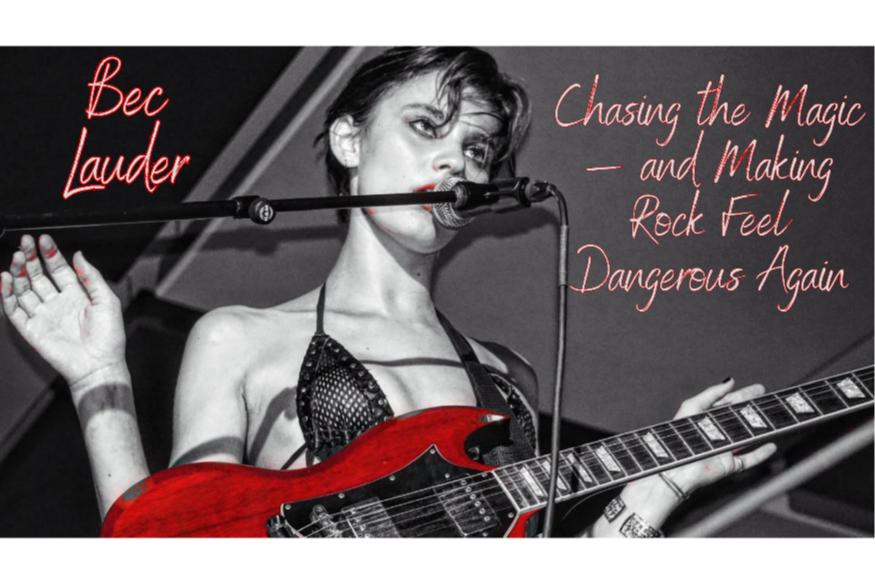
Even in casual footage and imperfect captures, Lauder commands attention in the way true frontwomen do: not by demanding it, but by making it impossible to look anywhere else. Audiences don’t drift toward the bar. They lock in. They watch. They react. They lean closer. It’s the kind of stage presence that can’t be manufactured and doesn’t need explanation.
That power is reaching beyond New York now. In one of the interview’s most revealing moments, Lauder recounts a whirlwind run through Paris. Her first show there drew about 15 people. On her next trip, she sold out two booked shows, got directly booked for two more, and ended the week playing to 700 people. That kind of momentum doesn’t come from hype. It comes from people seeing something real and telling other people they need to see it too.
Word of mouth still matters when the music hits hard enough.
And Bec Lauder’s music hits hard because it comes from a place deeper than performance. During the conversation, she reads from a notebook gifted to her by the very person who inspired much of The Vessel. It’s a quietly stunning moment — part manifesto, part diary entry, part artistic mission statement. In it, she writes about stumbling forward, searching for love and inspiration everywhere, chasing freedom, and believing there is “unfathomable beauty” inside even the idea of it.
That’s the key to Lauder, really. She’s not just writing songs about love or pain or growth. She’s trying to capture the magic hidden inside all of it.
“I think there’s still magic,” she says. “None of the magic is gone.”
For someone who admits she was once a deeply depressed kid — someone who felt burdened by how much she saw and understood — that perspective doesn’t feel naive. It feels earned. Bec Lauder isn’t ignoring the darkness. She’s choosing not to let it have the final word.
That choice is all over her music.
What’s especially exciting is that The Vessel may only be the beginning. Lauder and her band have since found what she calls the “final form” of The Noise — a tighter, more fully realized version of the group built around the chemistry and force of the three women at its core. If The Vessel was the sound of discovery, the next record may be the sound of full possession. Lauder hints that the new material is stronger than what came before, and if that’s true, the ceiling may be nowhere in sight.
You can already hear it happening: a young artist stepping into her own mythology in real time.
In an era obsessed with trends, algorithms, and disposable identity, Bec Lauder feels thrillingly human. Emotional without being precious. poetic without losing grit. Stylish without sacrificing substance. She doesn’t just sing about transformation — she sounds like someone living through it, in public, with the amps turned all the way up.
And that makes her dangerous in all the best ways.
Check out the full interview here!: She Wasn’t Trained… She Was POSSESSED! The Rise of Bec Lauder - Press Play Radio
Learn more about Bec Lauder and The Noise on her Mosaic profile.
Fans can also send Bec a message directly through Press Play Artist Letter.
If you want, I can also turn this into a shorter magazine-style web editorial version, a Facebook caption, and a video blurb to match it.





Comments(0)