April 02, 2026 - 2457 views
Written by Tina Houser
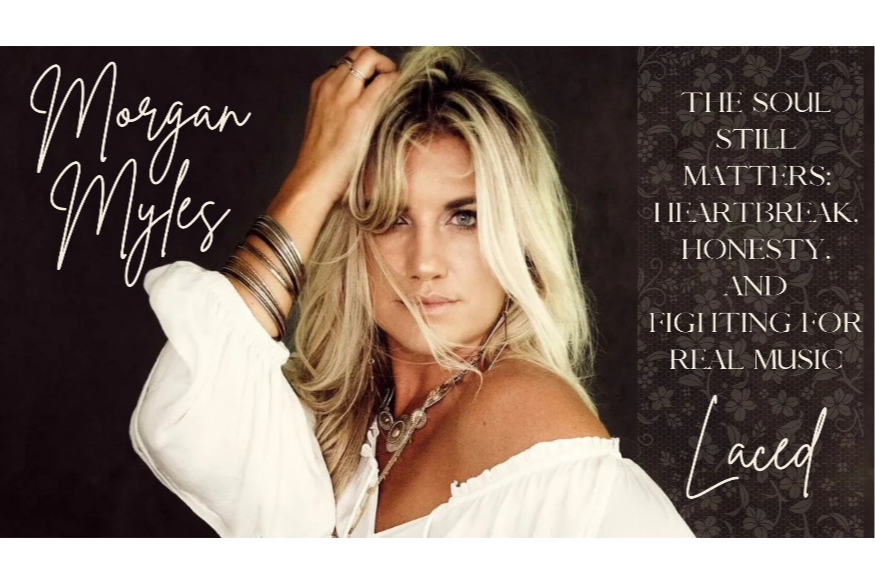
Morgan Myles doesn’t enter a conversation so much as she pours into it — quick-witted, self-aware, emotionally unguarded, and carrying the kind of voice that makes even casual banter feel like the opening line of a great American song. When she returned to Press Play Radio Conversations with The Don and Tina, the exchange moved the same way her music does: funny one minute, bruised the next, then suddenly wide open and soaring.
She was speaking on the eve of her album release, surrounded by the beautiful chaos that seems to follow artists who still insist on making things the hard way — with instinct, obsession, and heart. There were hundreds of battery-operated candles to wrangle, a missing shipment of donated wine to track down, and an album release party hanging just over the horizon. It was the kind of scene that feels almost too on-the-nose for a singer like Myles, whose work lives in the tension between glamour and unraveling, polish and pain.
That tension runs straight through Laced, the new album at the center of the conversation. For Myles, this isn’t just a record rollout. It’s the aftermath of a life split open and stitched back together in public. She spoke candidly about creating a visual companion piece for the album — a 45-minute short film built from the emotional architecture of the songs — while her real-life engagement was collapsing in the background. The ring in the film was her real ring. The original ending had to be reshot because life, as she put it, no longer ended in a wedding.
That kind of emotional overlap — where art stops being performance and starts becoming evidence — is what gives Myles her weight. There’s no alter ego here, no glossy persona to hide behind. She said it plainly: her brand has always been “completely real.” In an era built on filters, personas, and content churn, that almost feels rebellious.
And maybe that’s why her songs land the way they do.
When the conversation turned to Love Is Lonesome, Myles peeled back the song’s emotional core with the kind of honesty most artists save for memoirs. The track, written with Gary Nichols, isn’t just about heartbreak in the obvious sense. It’s about the constant ache of wanting something essential, something fragile, something that can heal you or hollow you out depending on whose hands it’s in. She described love as a force that can’t be bought, can’t be faked, can’t be taken for granted — a longing that can turn manipulative, abusive, beautiful, or redemptive. In her hands, even a title like Love Is Lonesome doesn’t read as defeat. It reads as testimony.
That perspective was shaped, in part, by the road to this album. Myles wrote across Nashville, Austin, and especially Muscle Shoals, where she found herself reconnected to something deeper than industry mechanics. She spoke about the town with near-religious reverence — not as a brand name, but as a reminder that music can still be soul-first, commerce second. In Muscle Shoals, she found people who were still protecting the sacred part of songwriting. You could hear in her voice that she needed that. Maybe a lot of artists do.
If Laced sounds lived-in, that’s because it was. Myles and her collaborators wrote roughly 80 songs for the project, with around 15 born in Muscle Shoals alone. The record itself was cut in Los Angeles with a cast of players pulled from across the map, including Nashville, Austin, and beyond. It was assembled the old-school way, with musicians in rooms, instincts being trusted, songs being shaped for feel as much as structure. Even the sequencing was treated like an art form. Myles explained that the order wasn’t just about narrative but about sonic flow — about how the ear travels through a record, how tension builds and releases, how a listener stays inside the emotional weather of it.
That reverence for songs — for what they mean, how they breathe, how they hold memory — also surfaced in her cover of America’s Sister Golden Hair. Slowed down and reimagined through her soul-country lens, the song becomes less of a classic-rock staple and more of a confession whispered after midnight. For Myles, it wasn’t just an iconic song worth revisiting. It mirrored her own life. The lyric about not being ready for the altar cut differently for someone living through the unraveling of an engagement while trying to keep moving forward. Her version honors the song’s history while making it ache in a new way, and the fact that America’s Jerry Beckley championed the rendition only deepens the poetic symmetry.
Still, what made the interview linger wasn’t just the music. It was the worldview beneath it.
Myles spoke with a kind of frustrated clarity about modern life — about social media, negativity, disconnection, and the exhausting demand that artists now be not only musicians, but full-time marketers, editors, content creators, and algorithm whisperers. She joked about viral bulldog videos and random TikToks outperforming actual artistry, but beneath the humor was a familiar exhaustion. Today’s artist is expected to do everything and somehow still remain inspired. Somewhere between rehearsal, travel, posting, editing, and self-promotion, the actual making of music gets squeezed thinner and thinner.
And yet Myles remains stubbornly committed to the thing itself.
She talked about Chile with the kind of awe that reminds you why artists endure any of this at all. Unsure of what to expect, she arrived in South America nervous about whether anyone would know her music. Instead, 700 people showed up. The room sold out. Fans sang back to her. For Myles, it was more than a successful show — it was a spiritual correction. Proof that the soul of music still matters, that audiences still recognize the real thing when they hear it, that the noise hasn’t drowned out the signal just yet.
That same spirit fuels the way she talks about country music, and about legacy more broadly. She isn’t interested in the shallow end of fame. She believes in earning it. In learning from those who came before. In suffering enough to understand what a song can carry. She referenced the old Nashville proving grounds, the humility they forced on artists, the way that process once shaped singers before they ever stepped into the spotlight. To Myles, something valuable is being lost in the shortcut era. Not just craft, but respect.
And still, she doesn’t come off bitter. She comes off convicted.
That distinction matters.
Because even in her sharpest observations — about ego, about AI, about online culture, about the shrinking attention span of modern audiences — Myles keeps circling back to the same idea: connection. Real human connection. Music that reminds people they are not alone. Stories that make people feel seen. Songs that don’t just soundtrack a moment, but rescue one.
By the end of the conversation, you got the sense that Morgan Myles is still fighting for something bigger than a chart position or a trend cycle. She’s fighting for the soul inside the machine. For the part of music that still bleeds, still comforts, still tells the truth when everything else is optimized to distract.
That may not be the easiest road in 2026. But listening to her talk — and listening to her sing — it feels like the only one she was ever meant to take.
To watch the full interview: Morgan Myles No Filters, the RAW Truth About Love & Music - Press Play Radio
To learn more about Morgan: https://mosaic.pressplay.me/profiles/morgan-myles
To write Morgan a letter: https://pressplay.me/artist-letter/morgan-myles
Comments(0)